
The AI That Wins in Financial Services Runs on Governed Unstructured Data
Continue the Conversation After CDAO Financial Services 2026.

- Type: Events
- Date: 02/02/2026
- Tags: Financial Services, Data Governance, AI Readiness, Unstructured Data
AI in Financial Services is Past the Experiment Phase
Artificial intelligence is no longer experimental in financial services.
68% of FS CDOs say AI or GenAI is their #1 priority.1
- 79% are already using AI for internal process automation.2
- 75% say AI is reshaping their operations.3
Most institutions are investing, piloting, and deploying AI across analytics, operations, and customer workflows.
Yet many AI initiatives stall before reaching scale. The issue isn’t intent, budget, or technology maturity. It’s unstructured data governance.
Why Unstructured Data Blocks AI at Scale
Roughly 80% of enterprise data is unstructured: contracts, complaints, call recordings, emails, and customer correspondence.
In financial services, this content holds:
-
some of the highest-value operational context
-
some of the highest-risk regulated information
AI systems increasingly depend on it. But when organizations cannot see what’s inside it, who can access it, or how it’s governed, AI becomes hard to operationalize and even harder to defend.
In regulated environments, you cannot ship AI you cannot explain to examiners. Only 26% of organizations are confident they can extract business value from unstructured data.4
In Financial Services, where models must withstand audit pressure, that confidence gap becomes a scale limiter.5

Download the Data X-Ray overview
loading...
The CDO and CIO Accountability Gap
CDOs are expected to deliver AI outcomes while also being measured on compliance and operational efficiency.
In financial services:
-
61% of CDOs measure compliance scores as a primary KPI (vs 44% overall)5
67% measure operational efficiency5
33% measure revenue growth as a primary KPI (vs 48% overall)5
CIOs are accountable for AI systems that must withstand scrutiny, even when the underlying data sits outside traditional governance models.
This tension isn’t cultural. It’s architectural.
Governance frameworks built for structured data do not extend cleanly into documents, messages, and free-form content. Institutions end up with a false choice between speed and safety.6
Why AI and Compliance are the Same Problem
AI initiatives don't fail because models underperform. They fail because leaders lack confidence in the data that feeds them.
The same visibility gap that creates regulatory exposure also limits AI return. When organizations can't govern unstructured data, they can't:
Confidently train or deploy AI models
Respond to audits with evidence instead of inference
Scale AI across regulated workflows
Prove to examiners what data was used, where it lives, and who had access
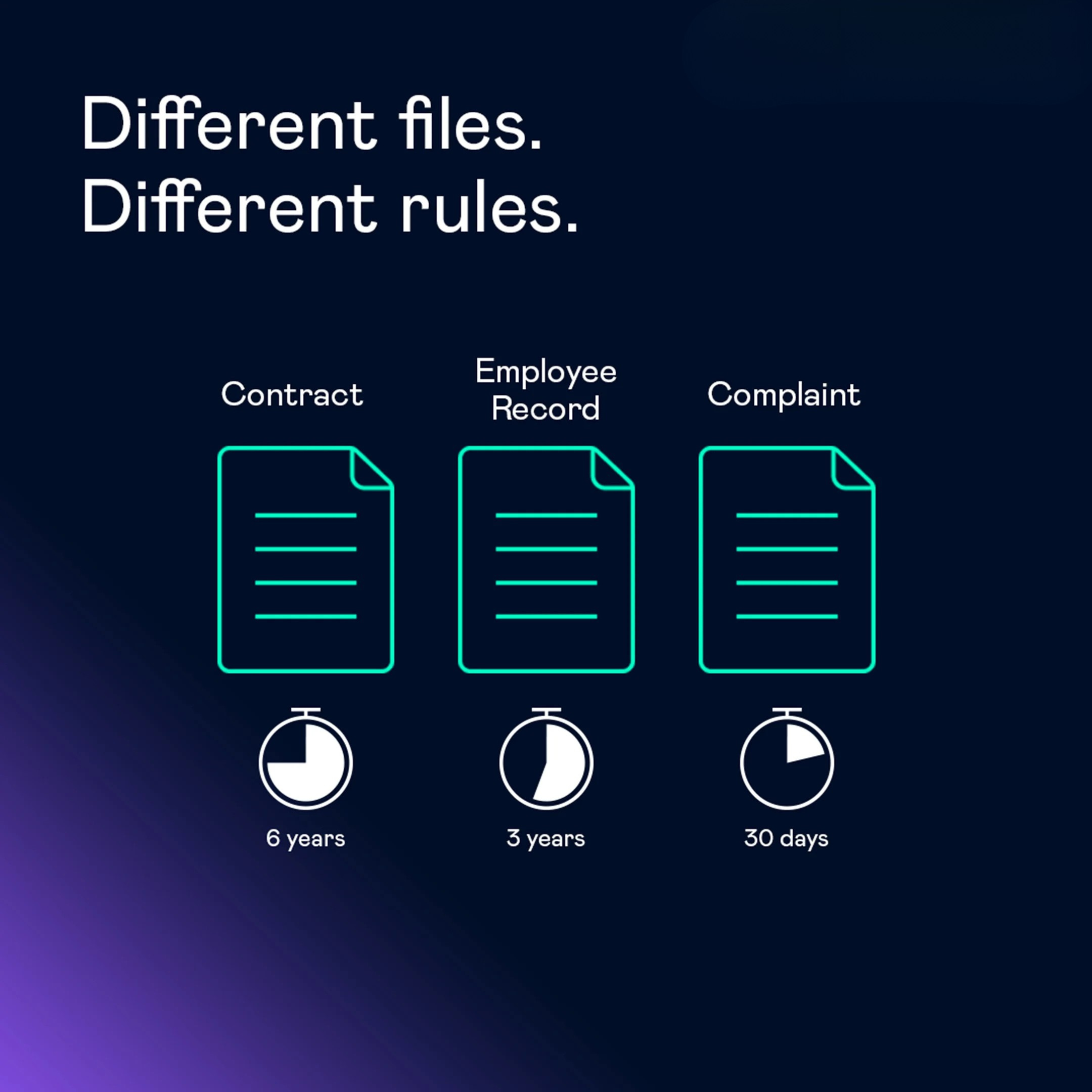
Regulatory pressure doesn't ease once models are in production. It intensifies. Examiners want to know:
What data you used to train it
Where that data lives
Who has access to it
Whether it contains undisclosed personal information
How you remediate when it does
For Financial Services, model durability depends on whether the data underneath can be traced, explained, and defended under regulatory scrutiny. That means governing unstructured data from the start, not retrofitting compliance after deployment.
What Leaders Gain From Governed Unstructured Data
Organizations that succeed with AI in financial services don't replace their governance stack. They extend it with solutions that provide:
Clear visibility into what's in files, who can access them, and where sensitive data lives
Defensible governance for audits and examinations
Confidence to operationalize AI at scale without creating new compliance risk
Audit trails that stand up to regulatory scrutiny
AI moves forward not because risk disappears, but because it becomes visible, explainable, and manageable.

AI That Holds Up
The future of AI in financial services won't be defined by experimentation speed. It will be defined by who can govern responsibly, explain decisions clearly, and stand behind outcomes under regulatory pressure.
The AI that wins will run on governed unstructured data. Everyone else is guessing.
Ohalo at CDAO Financial Services 2026
CDAO Financial Services brings together senior data, AI, and technical leaders to share how responsible AI is actually being deployed at scale in financial services.
This year’s conversations reinforced a core reality we’re seeing across the market: the gap between AI ambition and AI readiness comes down to unstructured data governance.
What stood out at CDAO:
- Compliance is entering the pipeline earlier, and “audit-ready” now means content-based proof, not policy statements.
- Governance changes when models touch contracts, complaints, call recordings, and customer correspondence, not just structured databases.
- The stat that landed: Only 26% of financial services CDOs are confident they can extract business value from unstructured data. That’s not a technology problem. It’s a visibility problem.
Because you can’t govern what you can’t see, and you can’t ship AI you can’t explain to examiners.
Footnotes:
